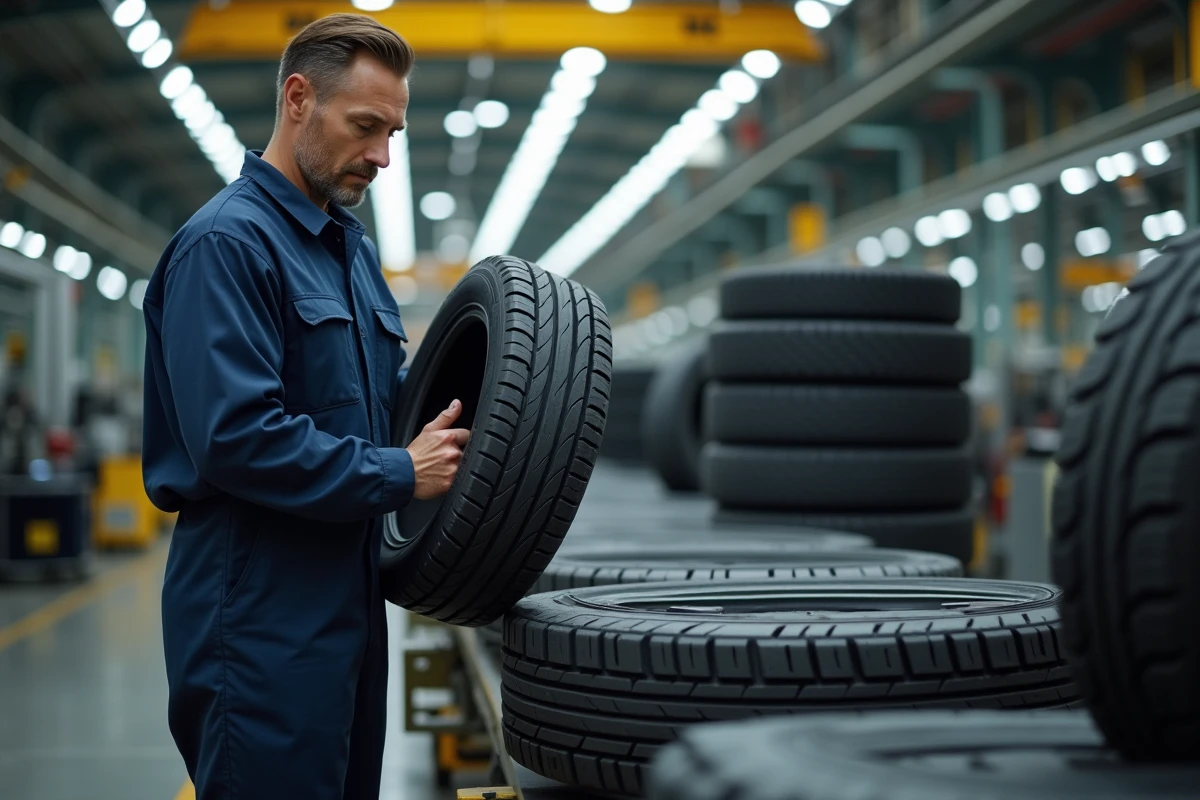
Kleber never explicitly mentions all its production sites in its technical data sheets. Some French factories continue to assemble tires of the brand, despite the acquisition by Michelin in 1981. Industrial logic distributes manufacturing across several European countries, without this diversification always being known to the public.
Specific supply chains apply to certain models, particularly for agricultural and utility tires. The structuring of the production network follows historical, economic, and technological criteria that explain the current location of the factories.
Kleber, a French brand with a unique journey
In 1910, the Société Française B. F. Goodrich laid the foundations of Kleber in Colombes. The factory produced its first tire the following year, marking the beginning of an industrial adventure firmly rooted in the French landscape. Over the decades, the brand established itself as a reference, navigating through conflicts, technological upheavals, and the explosion of the automobile. The headquarters moved to avenue Kléber in Paris after World War II, and the name evolved to Kleber-Colombes, a nod to its roots and the capital.
Kleber has multiplied innovations: the famous White Wall tire gave way to the Black Wall as early as 1935, before the White Bear, a pioneer of snow tires, made its appearance in 1947. The brand equips both the supersonic Concorde and the Twingo, a symbol of urban cars. Its mascot, a boxer dog, embodies the quiet robustness that spans generations. Despite the gradual expansion of production outside France, the national industrial footprint remains strong.
Kleber clearly positions itself in the Quality segment: reliability, accessibility, safety. In 2000, more than seven million tires sold propelled it to sixth place in Europe by volume. Yet, the question often arises: where are Kleber tires made? Behind this inquiry lies a need for clarity regarding the choice of sites, their history, and their impact on the territory.
Where are Kleber tires made? An overview of production sites
The Kleber industrial network is structured around several European centers, each with a specific role. On French soil, two factories symbolize this heritage: Clermont-Ferrand, the cradle of the tricolor tire, and Cholet, in the Pays de la Loire region. These establishments perpetuate a know-how that has been passed down and perfected, particularly in road and agricultural ranges. The technical requirements and the reputation of the French teams remain a guarantee of trust for many users.
Beyond France, the brand relies on the Zalău factory in Romania, which has become a key player in supplying Central and Eastern Europe. Following this, other units located in Spain, Italy, Germany, not to mention Japan and Thailand, enhance flexibility and security of supplies.
To summarize the main sites where the Kleber footprint is concretely manifested:
- Clermont-Ferrand: historic French site
- Cholet: specialization in certain ranges
- Zalău (Romania): strategic industrial anchorage
- Other sites: Spain, Italy, Germany, Japan, Thailand
Through this organization, Kleber successfully combines proximity, responsiveness, and international presence. Each tire reflects the interconnection of a solid network, attentive to safety standards and today’s logistical challenges.

From raw materials to the road: how is a Kleber tire born?
The genesis of a Kleber tire takes root long before assembly. It all begins with the rigorous selection of natural rubber, synthetic polymers, reinforcing additives, and technical textiles. This selection ensures robustness and performance, with one goal: to optimize rolling resistance without sacrificing safety.
The first industrial step is mixing: rubber, carbon black, silica, oils, and resins form a homogeneous paste. The recipe varies according to the destination: summer, winter, all-season, or agricultural tires. Next comes calendering, where the material is rolled out and then reinforced with textile or metallic layers, the true backbone of the tire.
The manufacturing combines expert gestures and automation. The layers are assembled, the tire takes shape on the drum before moving on to vulcanization: heat and pressure weld the structure, giving elasticity and strength to the whole.
Nothing escapes quality control: each Kleber tire undergoes thorough checks, from leak tests to balancing. The slightest deviation and the product is discarded. This level of demand explains the brand’s reputation among manufacturers like Volkswagen or Renault, and its ability to anticipate regulatory constraints, particularly with the Montagne Law for winter. The ecological challenge is also significant: Kleber is committed to carbon neutrality by 2050 and adjusts its processes to limit the impact of its tires on our roads.
Between tradition, innovation, and environmental vigilance, Kleber paves its way without ever stopping on the roadside. Behind each tire, a piece of industrial history and a challenge for the future.