
The name Aldi is a contraction of “Albrecht” and “Discount.” Behind this lexical shortcut lies a business model that has redefined the rules of food distribution in Europe and then worldwide. Understanding the history and origin of the Aldi brand requires going beyond the family anecdote to analyze the operational mechanisms that allowed a grocery store in Essen to become a network of over twelve thousand stores.
Private Label Model and Short Rotation: Aldi’s Operational Foundation
The fundamental lever of the Aldi model is not low prices per se, but the radical compression of the product range. While a traditional supermarket carries several tens of thousands of products, Aldi has historically limited its offering to a few hundred references, almost exclusively in private label (PL). This choice is not cosmetic: it conditions the entire chain, from supplier negotiations to warehouse logistics.
A reduced assortment allows for concentrating purchase volumes on each reference, giving the brand considerable bargaining power against producers. Suppliers accept very tight profit margins because orders are based on high and regular tonnages. Stock turnover is quick, which limits losses and the need for storage space.
This principle also explains the deliberately modest size of the stores. Less floor space means lower rents, fewer staff on the sales floor, and reduced shelf stocking time. Each square meter generates a revenue per unit of area that is higher than that of larger formats.
To better understand the foundations of this model, a look back at the history and origin of the Aldi brand helps to understand how each operational choice stems from decisions made as early as the 1950s.
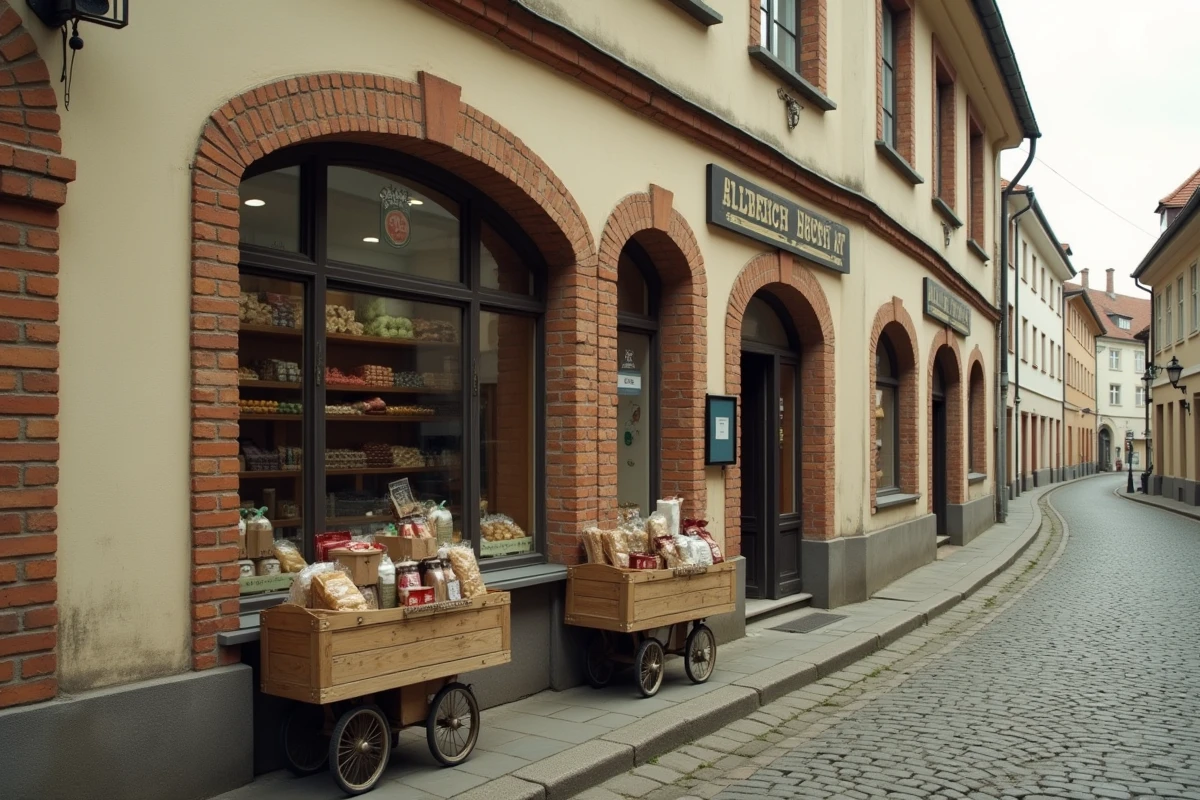
Split Between Aldi Nord and Aldi Süd: Two Companies, Two Distribution Strategies
The separation between Aldi Nord and Aldi Süd, formalized in 1961, is often reduced to a dispute over cigarette sales between brothers Karl and Theo Albrecht. This explanation is incomplete. The split primarily created two legally and strategically independent entities, each developing its own supplier relationships, brands, and geographical areas of operation.
Aldi Süd, led by Karl, pushed for international expansion earlier, particularly in the United States and Australia. Aldi Nord, under Theo’s direction, focused on northern Germany, France, the Benelux countries, and the Iberian Peninsula. In France, it is Aldi Nord (now Aldi Marché) that operates the network of stores.
This separation had an unexpected effect on internal competition: the two entities developed distinct corporate cultures, with varying levels of service, layout policies, and pricing strategies depending on the markets. This duality often complicates the analysis of observers who treat “Aldi” as a homogeneous block.
Shift Towards National Brands and Upmarket Positioning
The original model relied almost exclusively on private labels. Recent consumer panel data shows a significant increase in the presence of national brands on Aldi shelves, both in Nord and Süd. This strategic shift responds to dual pressures:
- Consumers, particularly in France and the UK, still associate the presence of well-known brands with a guarantee of quality, which hinders the conversion of certain customer profiles to pure hard discount
- The arrival of national brands allows for an increase in the average basket size and attracts a more affluent suburban clientele, a segment that Aldi has been heavily investing in since the pandemic
- The direct competition with Lidl, which made this shift earlier, has accelerated the movement to avoid losing market share in high-turnover categories like dairy products or beverages
The introduction of national brands does not replace private labels but complements them. The assortment remains deliberately limited: Aldi references one or two national brands per category, no more. The principle of assortment compression remains the cornerstone of the economic model.

Real Estate Strategy and Renewable Energy: Recent Levers
The most significant evolution in recent years concerns the choice of locations. Several market analyses document a rise in establishments in affluent suburban areas and retail parks, breaking with the image of a brand confined to working-class neighborhoods. This geographical repositioning is particularly visible in the UK and Spain.
On the energy front, Aldi has become one of the largest private funders of renewable energy in European food distribution. The sustainability reports from Aldi Nord and Aldi Süd published since 2022 indicate a rapid increase in photovoltaic production on the rooftops of stores and warehouses. In Germany and Austria, a significant portion of the electricity consumption of the sites is already covered by these solar installations.
This choice is not solely motivated by brand image. Photovoltaic self-consumption reduces the energy bill for buildings with high consumption (refrigeration, lighting), which directly strengthens the price competitiveness of the brand. The logic is consistent with the founding principle: every cost item not related to the product must be compressed.
Aldi in France: A Position Still Evolving
The French network, operated under the Aldi Nord banner through the Aldi Marché company, has long suffered from a modernization lag compared to German or British stores. The French outlets, often older and less well-located, did not offer the customer experience that the brand provided in other countries.
The renovation and relocation program launched in recent years aims to correct this gap. The new formats include slightly larger areas, a redesigned layout, and an expanded fresh product offering. This evolution places Aldi in more direct competition with traditional convenience stores, not just with Lidl.
The issue of commercial relations with French suppliers remains a point of tension. The pressure on purchase prices, characteristic of the model, clashes with regulatory frameworks on commercial negotiations and food producers’ margins. The balance between low prices for consumers and fair compensation for producers remains the main friction point of the discount model in France.
The story of Aldi is not just about two brothers and a grocery store. It is primarily a logistical and commercial system where each component (reduced assortment, dominant private label, controlled surface area, supplier pressure) reinforces the others. Recent adjustments, whether regarding national brands, suburban real estate, or photovoltaics, do not change this architecture: they adapt it to a distribution market that now demands more flexibility.