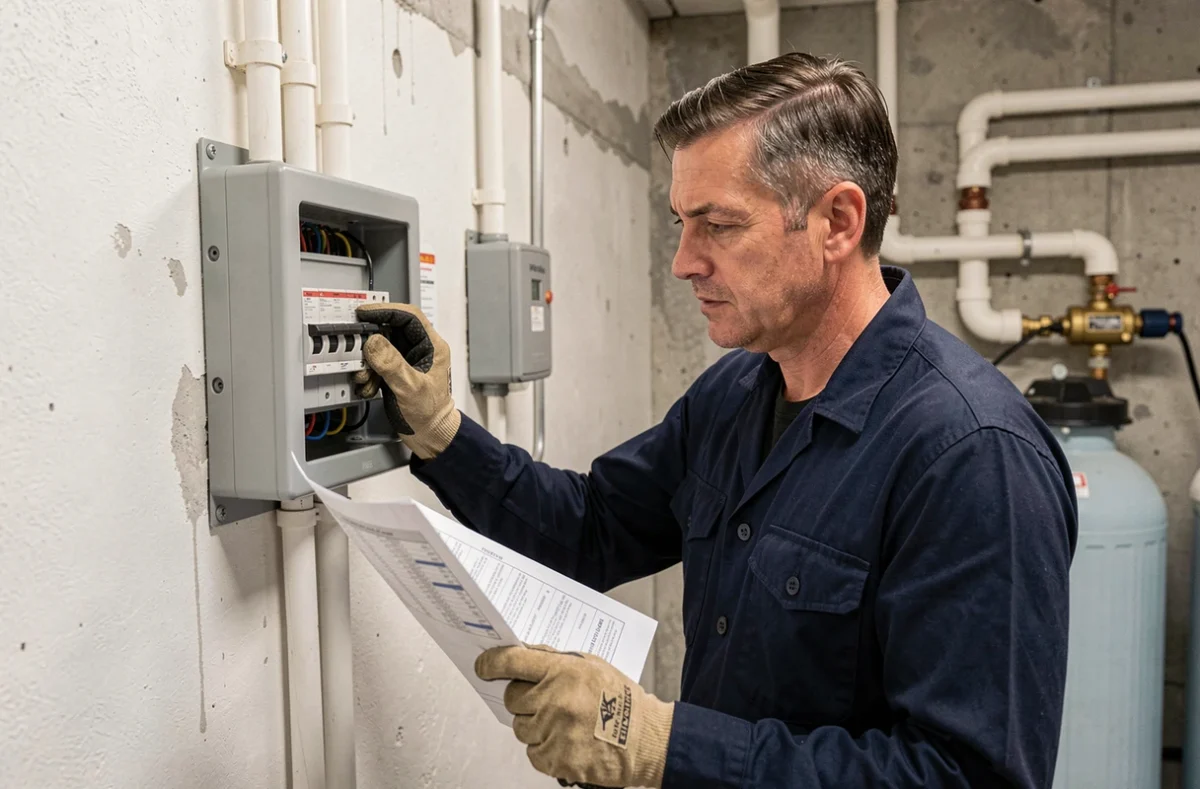
A pool equipment room houses the filtration pump, underwater lighting, automatic treatment system and sometimes a heat pump. The safety of this installation depends on the correct rating of the circuit breaker and the type of residual current protection installed upstream. These two parameters are governed by the NF C 15-100 standard, but how they are applied depends on the actual power requirements of the equipment and its location relative to the pool.
Circuit breaker rating and pump power: the figures to compare
The circuit breaker rating depends directly on the pump motor’s power. The calculation is simple: divide the power in watts by the supply voltage (230 V for single-phase power) to obtain the rated current, then select the next-highest circuit breaker rating.
| Pump power (W) | Calculated current (A) | Recommended circuit breaker | Cable cross-section (mm²) |
|---|---|---|---|
| 750 | 3,3 | 10 A | 1,5 |
| 1 100 | 4,8 | 10 A | 1,5 |
| 1 500 | 6,5 | 10 A | 1,5 |
| 2 000 | 8,7 | 10 A | 2,5 |
| 2 200 | 9,6 | 16 A | 2,5 |
This table covers most residential filtration pumps. Heat pumps often have a higher power draw and may require a 20 A or even 32 A circuit breaker with a 6 mm² cable. The rating plate on each appliance is the only reliable reference.
Before choosing a circuit breaker for a pool equipment room, take an inventory of all the circuits in the equipment room and check that each appliance has its own protection on a dedicated circuit from the subpanel.
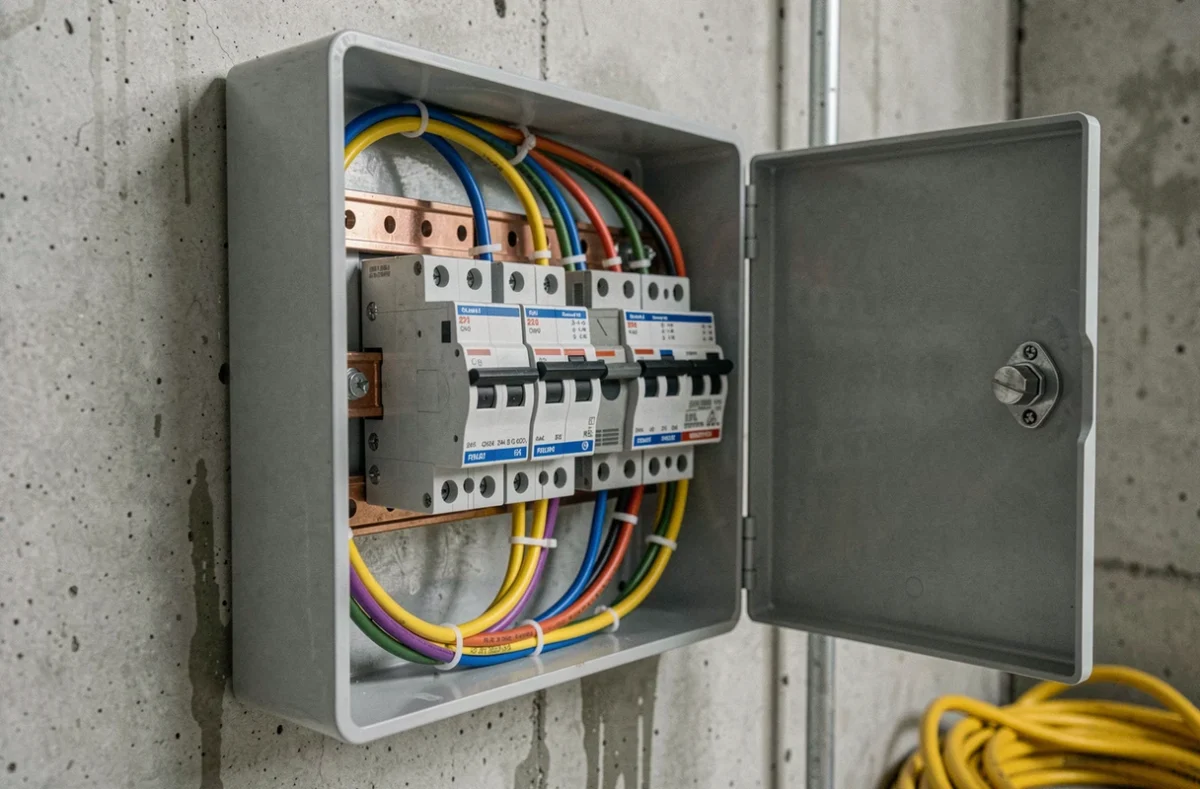
30 mA or 10 mA RCD: what the NF C 15-100 standard actually requires
The NF C 15-100 standard requires a 30 mA residual current device (RCD) upstream of each group of household circuits, including pool circuits. This threshold is sufficient to cut the power supply if a current leak poses a danger to people.
A 10 mA RCD provides more sensitive detection and trips faster. It is not mandatory, but it is particularly useful in an aquatic environment: the human body’s resistance drops on contact with water, making a leak of just a few milliamps potentially more dangerous than in a dry environment.
Type A or Type AC for the pool equipment room
Type AC protects against faults involving alternating current. Type A also detects pulsating DC components generated by certain variable-speed drives or heat pumps equipped with inverters.
- A standard filtration pump circuit can use a Type AC RCD.
- A heat pump with an inverter compressor requires a Type A RCD; otherwise, the device may fail to trip in the event of a fault.
- Underwater LED lighting powered by an electronic transformer is best protected by a Type A RCD, as the transformer may generate non-sinusoidal residual currents.
The choice of RCD type therefore depends on the technology of each connected appliance, not just its function.
Safety zones around the pool: a factor that determines which equipment is permitted
Section 7-702 of the NF C 15-100 standard defines concentric zones around the pool, numbered 0 to 2. Volume 0 is inside the pool, Volume 1 extends up to 2 metres above and around the water, and Volume 2 covers an additional band beyond that.
In Volumes 0 and 1, only equipment supplied by extra-low voltage (SELV, 12 V) is permitted for lighting. The SELV source itself must be located outside these volumes. This is separate from the choice of circuit breaker, but it determines the type of upstream circuit required: a dedicated safety transformer protected by its own circuit breaker in the equipment room’s electrical panel.
If the equipment room is more than 2 metres from the edge of the pool, it is outside the regulated zones. It can then house a standard subpanel with standard equipment, provided the enclosure’s ingress protection (IP) rating is suitable for the ambient humidity.
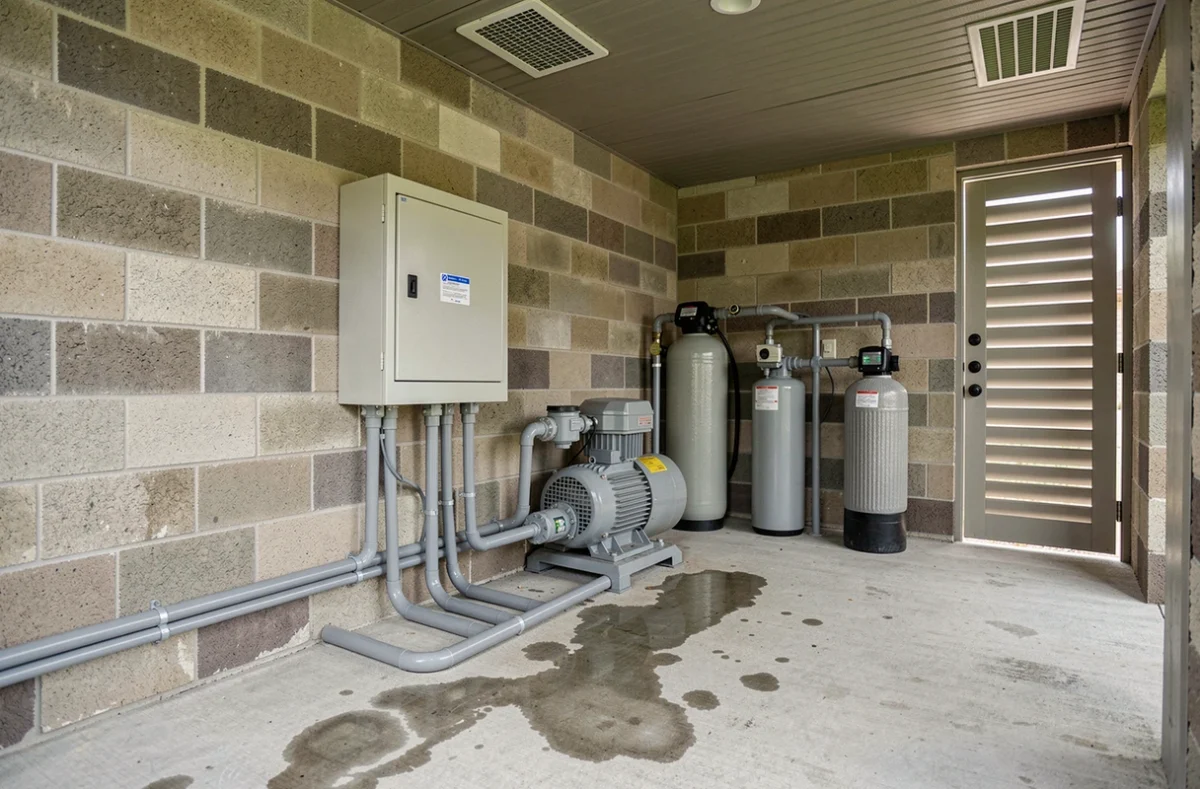
Equipotential bonding and grounding: the circuit breaker alone is not enough
An RCD detects current leaking to earth. Local equipotential bonding connects all the metal components around the pool (ladder, metal coping, inspection chamber, concrete reinforcement) to eliminate potential differences. These two measures serve complementary purposes: one disconnects the power, while the other equalizes potential.
Without properly installed equipotential bonding, an RCD may fail to detect certain faults because the leakage current flows between two metal parts without passing back through earth. An electrician with a continuity tester can verify that the bonding is compliant.
Thermal-magnetic motor circuit breaker for the pump
An adjustable motor circuit breaker (thermal-magnetic) protects the pump against prolonged overloads and short circuits. Set its rating to the nominal current shown on the pump’s rating plate. This component, which is separate from the subpanel circuit breaker, can save the motor if the rotor jams or if a phase is lost in a three-phase installation.
The combination of a circuit breaker in the panel, an upstream RCD and a motor circuit breaker at the pump provides the most complete protection for a pool equipment room. Each component covers a type of fault the others do not detect: overcurrent, earth leakage and mechanical overload. If even one link is missing, the protection system is no longer complete.