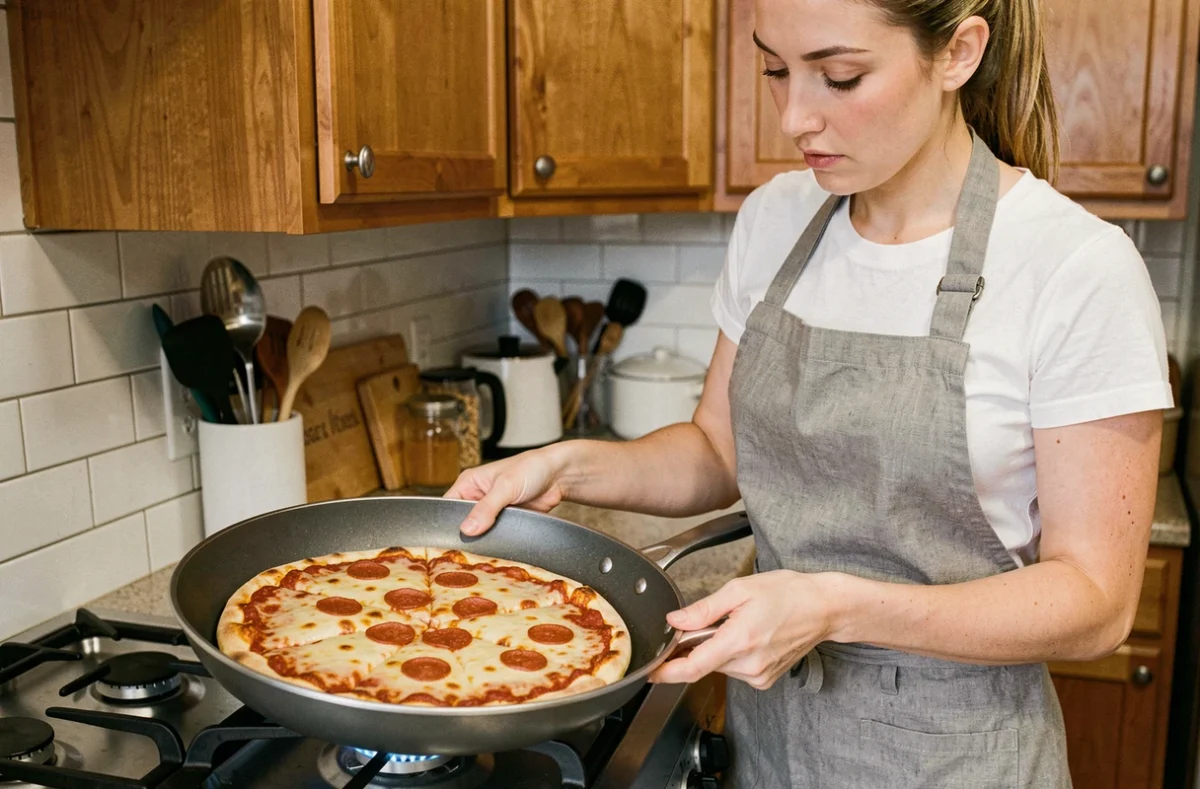
Your oven is broken, or you simply don’t have one. The frozen pizza is waiting in the freezer, and the skillet seems to be the only option. Good news: a skillet is enough to cook a frozen pizza, as long as you understand how heat circulates in this context, which is very different from an oven. The main trap can be summed up in one sentence: the bottom burns while the center remains cold.
Why frozen pizza burns in a skillet: the real heat problem
In an oven, heat surrounds the pizza from all sides. In a skillet, it comes only from below. The crust in direct contact with the metal heats up very quickly, while the toppings and the center of the pizza remain cold for much longer.
This imbalance is what traps most people. The cheese is just starting to melt while the base is already black. As the site Gourmandises et Bavardages reminds us, the color of the bottom says nothing about the temperature in the center of the pizza.
Have you ever noticed that a pizza taken out of the freezer is as rigid as cardboard? This frozen mass acts as a thermal barrier. The base absorbs all the energy while the middle remains frozen. Turning up the heat to speed things up only makes the problem worse.
Cooking frozen pizza in a skillet: the method with low heat then finishing
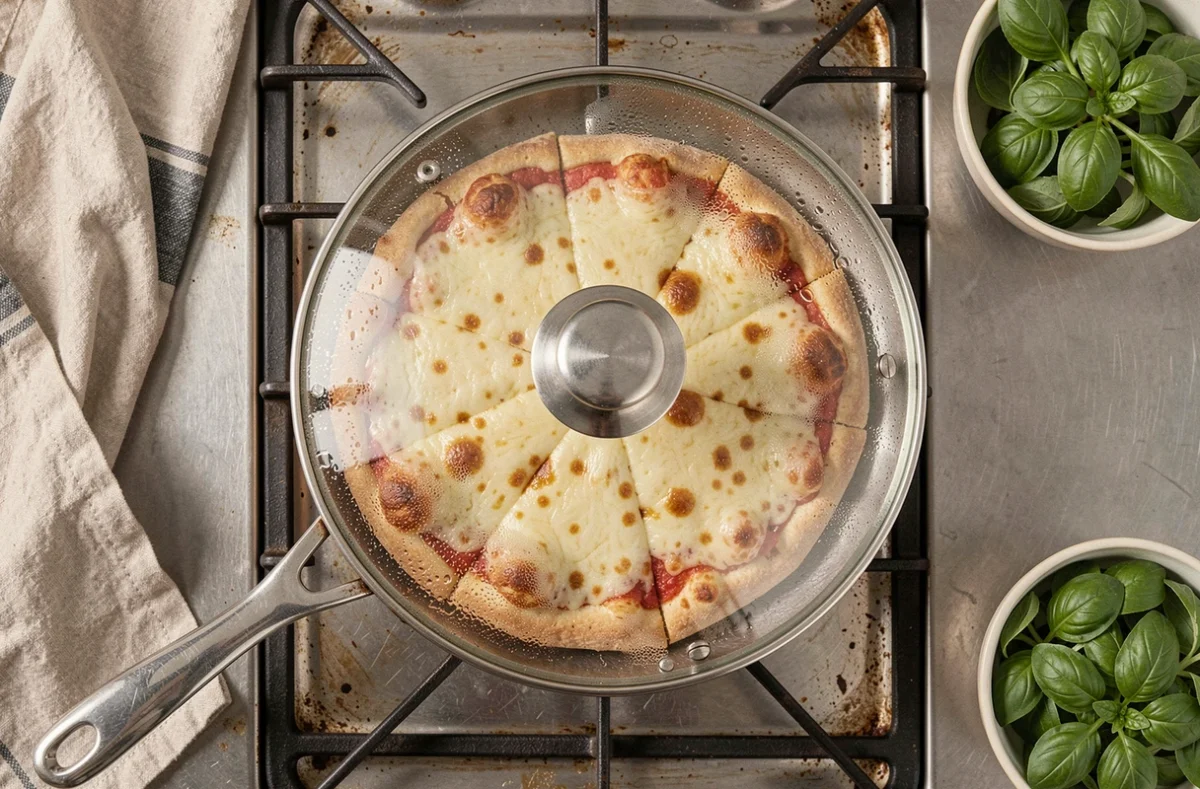
The technique relies on two distinct phases. The first uses a lid to trap heat from above. The second removes it to regain crispiness.
Covered phase: raising the heat everywhere
Place the pizza (cut or whole depending on the size of your skillet) on a lightly oiled surface. Set to low heat from the start. Cover immediately.
The lid creates a mini oven effect: steam and heat rise towards the toppings and cheese. This step takes time, but it’s what prevents the bottom from burning.
- Keep the heat low throughout this phase, even if nothing seems to be happening in the first few minutes
- Check the bottom by lifting an edge with a spatula after a few minutes: it should be barely golden, not brown
- The cheese starting to melt is the signal that heat has reached the center
Uncovered phase: drying and crisping the crust
Remove the lid when the cheese is melted. The accumulated steam softens the crust, and that’s normal. Without the lid, the moisture evaporates and the base becomes crispy again.
You can slightly increase the heat at this stage, but without excess. Monitor the bottom every thirty seconds or so. As soon as it is golden and firm to the touch, the pizza is ready.
Choosing the skillet and preparation before cooking
A large non-stick skillet makes the job easier. It reduces the risk of sticking and allows you to slide a spatula under the crust without tearing it. If your pizza hangs over the edge, cut it into slices before cooking: it’s much simpler than trying to fit a 30 cm pizza into a 24 cm skillet.
Letting the pizza sit for a few minutes at room temperature before placing it in the skillet reduces the thermal gap. The crust loses some of its surface cold, which helps the center heat up faster once cooking begins.
On the fat side, a drizzle of olive oil is sufficient. Its role is twofold: to prevent the crust from sticking and to conduct heat more evenly between the metal and the base.
Common mistakes that burn pizza in a skillet
The first mistake is starting with the heat too high. The instinct to want to go fast is understandable, but it consistently leads to a black base with a lukewarm center.
If the bottom browns too quickly, lowering the heat is always preferable to prolonging cooking at high power. Intense heat colors the base long before the middle is cooked.
The second mistake: never lifting the pizza to check. The only way to know how the base is doing is to look. Slide a spatula under an edge every two or three minutes.
- Don’t flip the pizza like a pancake: the toppings will come off and the result will be a disaster
- Don’t place the pizza on a skillet that’s already hot: the crust will seize before you even have time to cover it
- Don’t keep the lid on throughout the cooking: the bottom will remain soft and spongy
The third trap: relying solely on the color of the cheese. The cheese may appear melted on the surface due to the steam, while the center of the crust is still frozen. Touch the center of the pizza with the back of a finger: if it’s warm, it’s good.
Cooking a frozen pizza in a skillet requires a bit of patience, not complicated technique. Low heat, covered, then uncovered finishing: this simple sequence solves most problems. The only real enemy is haste.