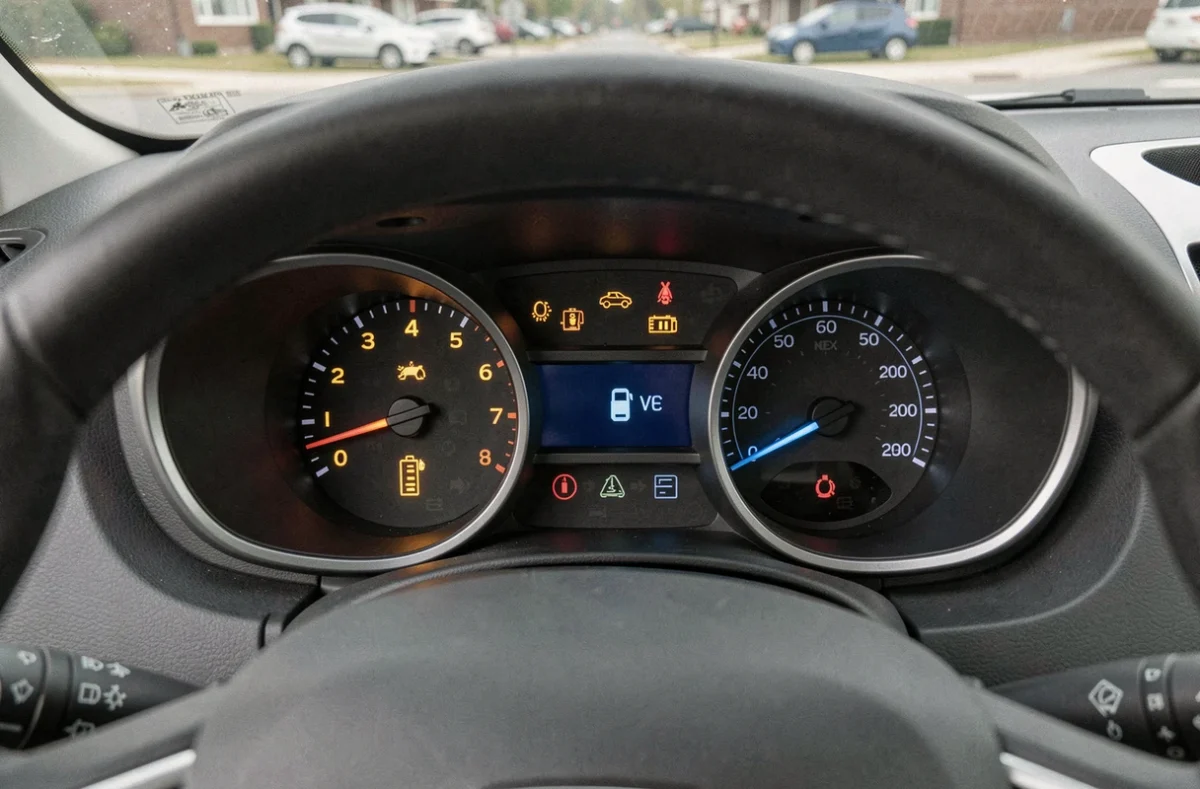
The dashboard indicators of a Dacia do not form a universal list. The official Dacia user manual specifies: the presence and operation of displays and indicators depend on the equipment and the country of sale. A 2018 diesel Duster does not display the same indicators as a 2026 electric Spring equipped with a 7-inch digital dashboard. Relying on a single reading grid for all models exposes one to misinterpretation errors.
Dacia Digital Dashboard: What Changes with Recent Generations
The Dacia models sold in recent years have undergone a notable evolution in their instrumentation. The latest models, such as the new Sandero and the new Spring, feature a customizable digital screen that replaces the old combination of dials and fixed pictograms.
This transition has a direct consequence on the reading of alerts. On a classic dashboard, a red or orange light illuminates at a fixed location. On a digital screen, the display of alerts varies according to the view selected by the driver. The pictogram may appear in a different corner, accompanied by a textual message that the old combination could not display.
The official manual also indicates that the activation of certain indicators is accompanied by a message. Relying solely on the color or shape of the light without reading this text amounts to ignoring the most precise information the vehicle transmits. To find a list of Dacia dashboard indicators with their associated pictograms, one must cross-reference the documentation with the exact generation of the vehicle.

Dacia Zigzag Indicator: A Multifunction Light Often Misunderstood
The zigzag indicator is probably the most sought-after light by Dacia owners. Its pictogram, a sine wave in a rectangle, does not resemble any standardized symbol found in other manufacturers. This indicator is specific to Dacia and Renault vehicles.
Its color determines the severity of the detected issue. In orange, it signals an anomaly that requires a quick check, without necessitating immediate stop. In red, it indicates a serious malfunction: the vehicle must be immobilized as soon as possible.
Zigzag Indicator Associated with Other Lights
The zigzag rarely appears alone. Its meaning becomes clearer when it lights up in combination with other indicators:
- Orange zigzag accompanied by the wrench symbol: the alert points to maintenance to be performed, often an overdue oil change or a missed maintenance interval.
- Orange zigzag with the engine light (check engine): a problem related to the powertrain is detected, which can range from a faulty sensor to an injection defect.
- Orange zigzag associated with the tire pressure light: the loss of pressure in one or more tires has triggered the TPMS monitoring system.
- Red zigzag, regardless of the combination: vehicle stop recommended, workshop visit necessary.
On Duster, Sandero, Sandero Stepway, Logan, Lodgy, Dokker, and Jogger models (petrol, diesel, or LPG), the orange zigzag remains the default multifunction indicator to signal a wide range of anomalies. It is this versatility that makes it difficult to interpret without diagnostic tools.
OBD Diagnostics on Dacia: Reading Beyond the Light
A light illuminated on the dashboard only provides a surface indication. The vehicle’s electronic system records an error code (DTC code) that specifies the exact nature of the fault. Accessing this code requires an OBD reader plugged into the vehicle’s diagnostic port, usually located under the steering wheel.
OBD diagnostics allow distinguishing a minor fault from a serious breakdown when the zigzag or engine light illuminates. Without this step, a driver may either ignore a serious problem or pay for unnecessary workshop intervention for a simple dirty sensor.
Field reports vary on this point: some Dacia owners report persistent alerts after restarting the vehicle, without any real mechanical problem being detected. These situations may stem from a software defect rather than a hardware failure.
Persistent Alerts and Software Updates
A light that remains on after several restarts, or that disappears and then reappears without apparent reason, is not always a sign of mechanical failure. Reports published on the Dacia Community mention display issues related to the multimedia software, requiring an update at the workshop.
A persistent alert may require a software update rather than mechanical repair. This distinction is rarely mentioned in general guides, which treat each light as an exclusively mechanical symptom.

Dacia Red Lights: Indicators That Require Vehicle Stop
The color code of automotive lights follows a logic common to all manufacturers. Red signals a danger or malfunction that compromises safety. On a Dacia, the most common red lights concern engine temperature, oil pressure, braking circuit, airbag, and battery.
- Red engine temperature light: the coolant has reached a critical level, driving increases the risk of engine damage.
- Red oil pressure light: the engine is no longer properly lubricated, an immediate stop protects internal parts.
- Red brake light: insufficient brake fluid level or handbrake still engaged, to be checked before resuming the road.
- Red airbag light: the passive restraint system has a fault, it will not deploy correctly in the event of a collision.
A red light always requires a quick and safe stop of the vehicle. Unlike orange lights, it does not allow for driving to the next garage.
Orange lights, on the other hand, signal anomalies to be addressed within a reasonable timeframe: tire pressure to correct, ESP system deactivated, low fuel level, or maintenance to plan. They do not require immobilization, but ignoring them for too long can turn a minor issue into an expensive breakdown.
Reading a light on the dashboard of a Dacia is not limited to recognizing a pictogram. The vehicle’s generation, engine type, screen type, and associated textual messages form a whole that must be considered in its entirety. Consulting the user manual corresponding to one’s exact model remains the most reliable reflex before any interpretation.